
Buit Not Born
The Making of Engineered Quartz
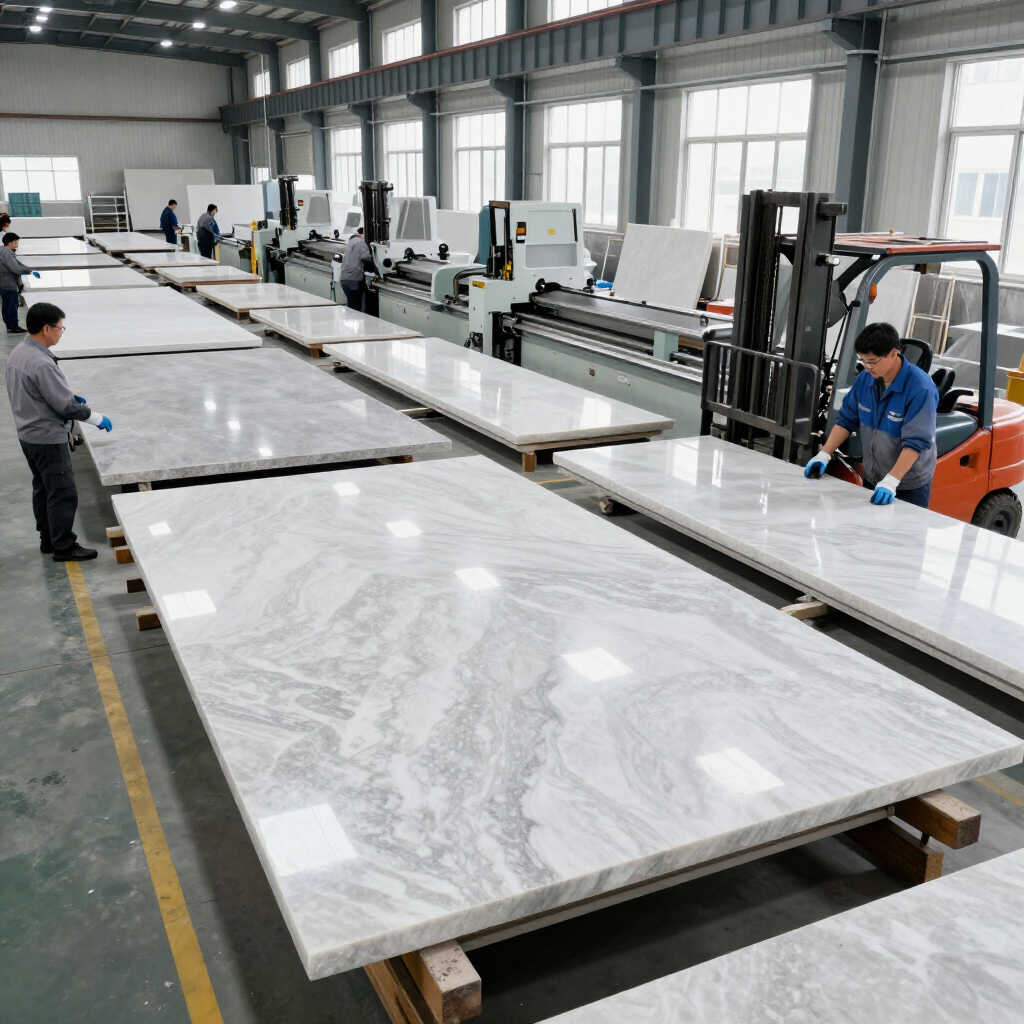
Unlike granite, quartz surfaces don't exist in nature. They're manufactured — and the process behind them is more sophisticated than most people realize.
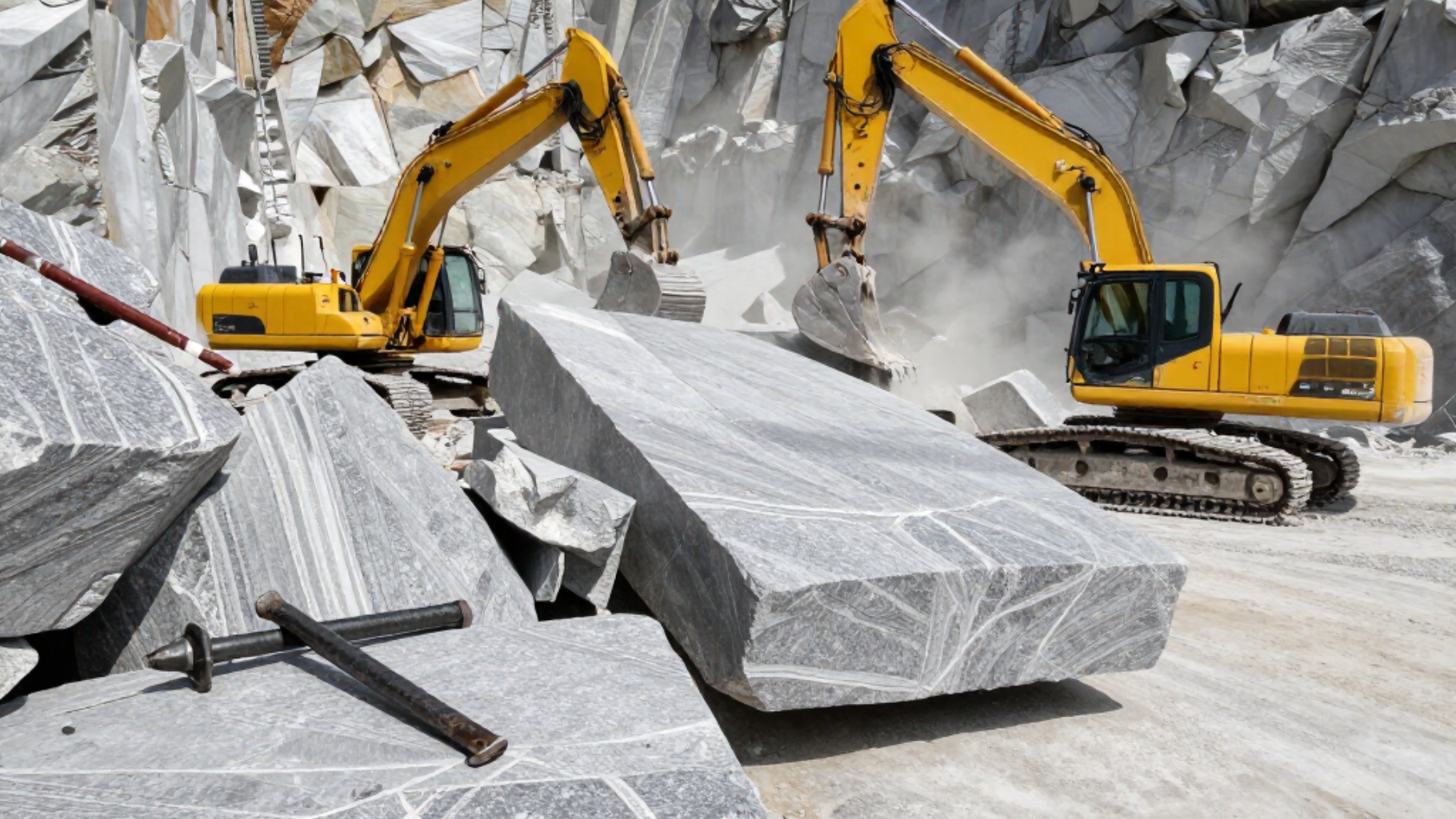
When a client asks me whether they should choose granite or quartz, the first thing I tell them is this: you're not really comparing two types of stone. You're comparing a natural material with a manufactured one. Granite is quarried. Quartz is engineered. Understanding that distinction — and the industrial process behind it — gives you a much clearer picture of what you're actually buying, and why it performs the way it does.
Engineered quartz has become one of the dominant countertop materials in the residential market over the past two decades. Brands like Caesarstone, Silestone, and Cambria have made it a household name. But very few homeowners — or even people in the trade — know much about how it's actually made, where the raw materials come from, or how it moves through the supply chain to reach a fabricator's shop. Let's walk through it.
01
What Engineered Quartz Actually Is
Engineered quartz — often called "quartz surfaces" in the trade — is a composite material, not a solid stone. A typical slab is composed of roughly 90–93% ground quartz aggregate (silicon dioxide, one of the hardest naturally occurring minerals on Earth) bound together with 7–10% polymer resins and pigments. Some formulations also incorporate recycled glass, mirror fragments, shells, or metalite particles to achieve specific visual effects.
The quartz aggregate itself is sourced primarily from quarries in the United States, Europe, and Asia. High-purity silica sand and crushed quartz crystal are the most common raw inputs. Unlike granite, which arrives at a fabrication shop as a finished slab, engineered quartz starts as a pile of industrial minerals and chemicals that must be transformed through a controlled manufacturing process.
Engineered quartz starts as a pile of industrial minerals and chemicals. The finished slab is the result of a precisely controlled manufacturing process — not millions of years of geology.
02
The Manufacturing Process: Vibrocompression Under Vacuum
The dominant method for producing engineered quartz slabs is a patented process known as Bretonstone technology, developed by the Italian company Breton S.p.A. in the 1980s. Nearly every major quartz manufacturer in the world — regardless of their brand name — licenses or operates on a variant of this technology. Here's how it works.
⚗️
Blending the Mix
Ground quartz aggregate of varying particle sizes is weighed and blended with polymer resin (typically unsaturated polyester), pigments, and any decorative additives. Particle size distribution is carefully engineered — larger aggregate gives a coarse, granite-like visual; finer aggregate produces a smoother, more uniform appearance. The exact formula is each manufacturer's most closely guarded trade secret.
📐
Mold Filling & Distribution
The blended mix is distributed evenly across a flat mold or conveyor surface to the desired slab dimensions — typically around 120" × 55" (roughly 3m × 1.4m), though jumbo formats are increasingly common. This distribution process is highly automated and monitored to ensure consistent thickness and material distribution across the slab surface.
🔩
Vibrocompression Under Vacuum
This is the critical step. The filled mold enters a Bretonstone press, which simultaneously applies intense vibration and compressive force — while drawing a vacuum to remove all air from the mix. The combination compacts the material to near-maximum density and eliminates voids that would weaken the slab. The result is a material with extremely low porosity — far lower than most natural stones.
🌡️
Curing
The compressed slab is moved to a curing oven, where controlled heat (typically around 90–100°C) catalyzes the polymerization of the resin, locking the aggregate permanently in place. Cure times vary by formula and slab thickness but typically run 45–90 minutes. After curing, the slab is a rigid, dimensionally stable composite panel.
✨
Calibration & Surface Finishing
Cured slabs are calibrated to precise thickness tolerances — typically ±0.5mm — on diamond abrasive grinding lines. They then pass through multi-stage polishing lines, where progressively finer abrasive heads bring the surface to a high gloss. Alternatively, slabs can be honed (matte), leathered (textured), or sandblasted depending on the product spec. Final thickness is almost always exactly 2 cm or 3 cm.
🔍
Quality Control & Inspection
Finished slabs pass through automated optical inspection systems that scan for color consistency, surface defects, thickness variation, and structural irregularities. Slabs that fall outside tolerance are downgraded or destroyed. Leading manufacturers maintain extremely tight consistency standards — which is one of quartz's key selling points over natural stone.
03
Where Quartz Is Made — and Why It Matters
Unlike granite, which is quarried wherever geology put it, quartz manufacturing plants can be built almost anywhere with access to raw materials, energy, and transportation. This has led to a global but concentrated manufacturing landscape with important implications for pricing and supply chain risk.
Premium brands like Cambria (USA), Caesarstone (Israel and USA), and Silestone (Spain) operate their own manufacturing facilities in their home countries and position their products accordingly. A significant and growing share of the market, however, is served by Chinese manufacturers who supply both private-label and branded product to U.S. distributors at substantially lower price points.
The Silica Dust Controversy and Workplace Safety
The engineered quartz industry has faced serious scrutiny in recent years over occupational silica dust exposure. Cutting, grinding, and polishing quartz surfaces generates fine respirable silica particles — and workers with prolonged exposure face elevated risk of silicosis, a severe and irreversible lung disease. Australia, Spain, and Israel have each reported clusters of silicosis cases among stone fabricators, leading to new regulations, water suppression requirements, and respiratory protection mandates. Reputable fabrication shops operate wet-cutting equipment and maintain strict dust control protocols. If you're a homeowner evaluating a fabricator, it's worth asking how they handle silica dust management — it tells you a lot about how seriously they take their craft and their people.
04
Distribution: A More Controlled Supply Chain Than Granite
The distribution model for engineered quartz differs from granite in one important respect: brand control. Because quartz is a manufactured product with consistent specifications, major brands invest heavily in managing their distribution channels, authorized dealer networks, and warranty programs. Buying Caesarstone through an unauthorized dealer, for example, may void the manufacturer's warranty.
Most branded quartz reaches the U.S. market through a network of authorized distributors — regional stone distributors that carry the brand's full product line, maintain display samples, and provide sales training to fabricators. These distributors then sell to fabricators like Cabinet Supply Plus, who may stock popular SKUs or order on demand. Larger fabricators often negotiate direct pricing tiers based on volume commitments.
Private-label and commodity quartz — particularly material produced in China — typically moves through a more open distribution chain, arriving at the same stone yards and importers that carry natural stone. This material can offer excellent value but generally lacks the brand-backed warranty, consistent QC documentation, and customer support infrastructure of the premium brands.
05
What Engineered Quartz Means for the Fabricator
From a fabrication standpoint, engineered quartz is both more forgiving and more demanding than natural granite. It's more forgiving because it's dimensionally consistent — no surprises in thickness, no unexpected fissures, no quarry variations to work around. It's more demanding because its hardness and abrasiveness wear tooling faster, and because its resin content makes it sensitive to heat in ways granite is not.
Cutting quartz requires diamond tooling rated for engineered stone, wet cutting at all stages, and proper dust suppression. Seaming quartz requires color-matched epoxy and careful attention to pattern alignment on book-matched or veined designs. The rise of dramatic waterfall edges and ultra-thin 1.2 cm formats has added further complexity to what was once considered a simpler material to work with than natural stone.
For the client, engineered quartz offers genuine advantages: consistent color across multiple slabs, near-zero porosity (no sealing required), and excellent resistance to staining and scratching under normal use. Its weakness is heat — polyester resin can discolor or crack from direct contact with hot pans, something natural granite handles more gracefully. A good fabricator will make sure every quartz client understands that before installation day.
Quartz offers consistency that nature cannot. What it trades away is the irreplaceable character of a material that formed before human beings existed.
Whether quartz or granite is the right choice depends entirely on how a client lives and what they value in a surface. Both materials have earned their place in the market. But as fabricators, our job is to know both deeply — from the factory floor and the quarry face, all the way to the finished edge profile. That knowledge is what separates a shop that installs countertops from one that genuinely serves its clients.
Have questions about how quartz and granite compare for your specific project? We'll give you a straight answer — no upsell, just experience.