
From the Mountain to Your Countertop
How raw granite travels thousands of miles — from quarry blast to fabrication shop — before it ever meets a saw blade.
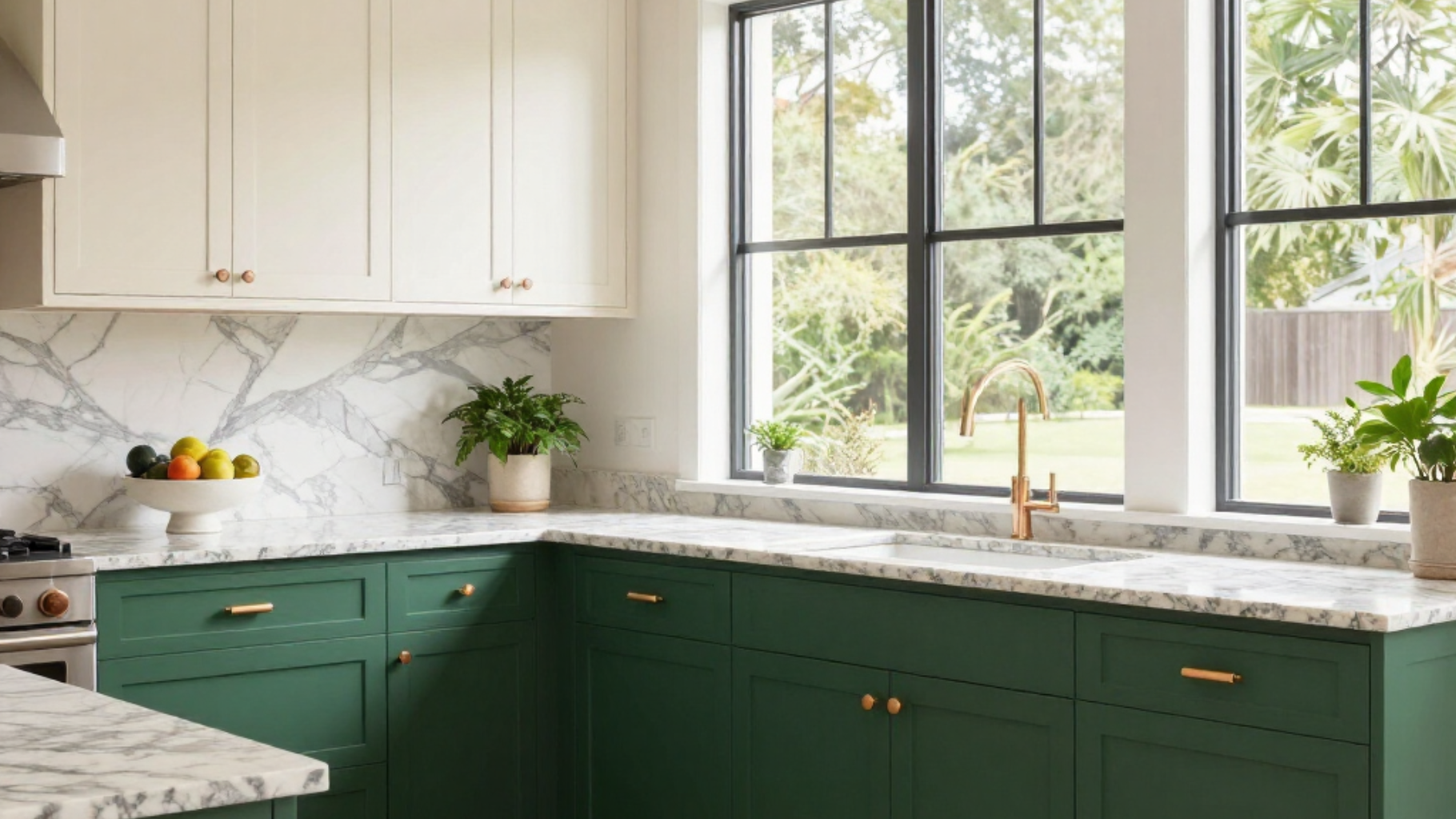
Most homeowners who walk into a stone yard see a finished slab — a gleaming, veined surface waiting to become a kitchen island or bathroom vanity. What they rarely consider is the extraordinary industrial journey that brought it there. Granite doesn't begin as something beautiful. It begins as an explosion.
As someone who has spent years on the fabrication side of this trade, I find that understanding the full supply chain changes the way you look at every piece of stone. It also makes you a smarter buyer, a better specifier, and — if you're in the business — a more credible partner to your clients. Here's how it all works.
01
Quarrying: Where Stone Becomes a Product
Granite forms deep within the Earth's crust over millions of years as magma slowly cools. The world's most prized deposits are concentrated in Brazil, India, Italy, Spain, China, and parts of Africa — with Brazil alone supplying a significant share of the exotic material you'll find in North American stone yards.
Quarrying granite is a precise demolition operation. Workers use a combination of wire saw cutting, diamond-tipped core drilling, and controlled blasting to extract massive "primary blocks" — rough rectangular masses that can weigh anywhere from 15 to 30 metric tons. The goal at this stage is not beauty; it's geometry. A clean, square block with minimal cracking commands a far higher price than a fractured one, because it will yield more usable slabs downstream.
A clean, square block with minimal cracking commands a far higher price than a fractured one — it will simply yield more usable material downstream.
Once extracted, blocks are moved to a staging area at the quarry site, inspected for structural integrity, and assigned a grade. Premium blocks go to premium processing plants. Lower-quality material may be sold to producers of tiles, pavers, or crushed aggregate. Nothing is wasted in granite production.
02
Processing: Turning Raw Blocks into Market-Ready Slabs
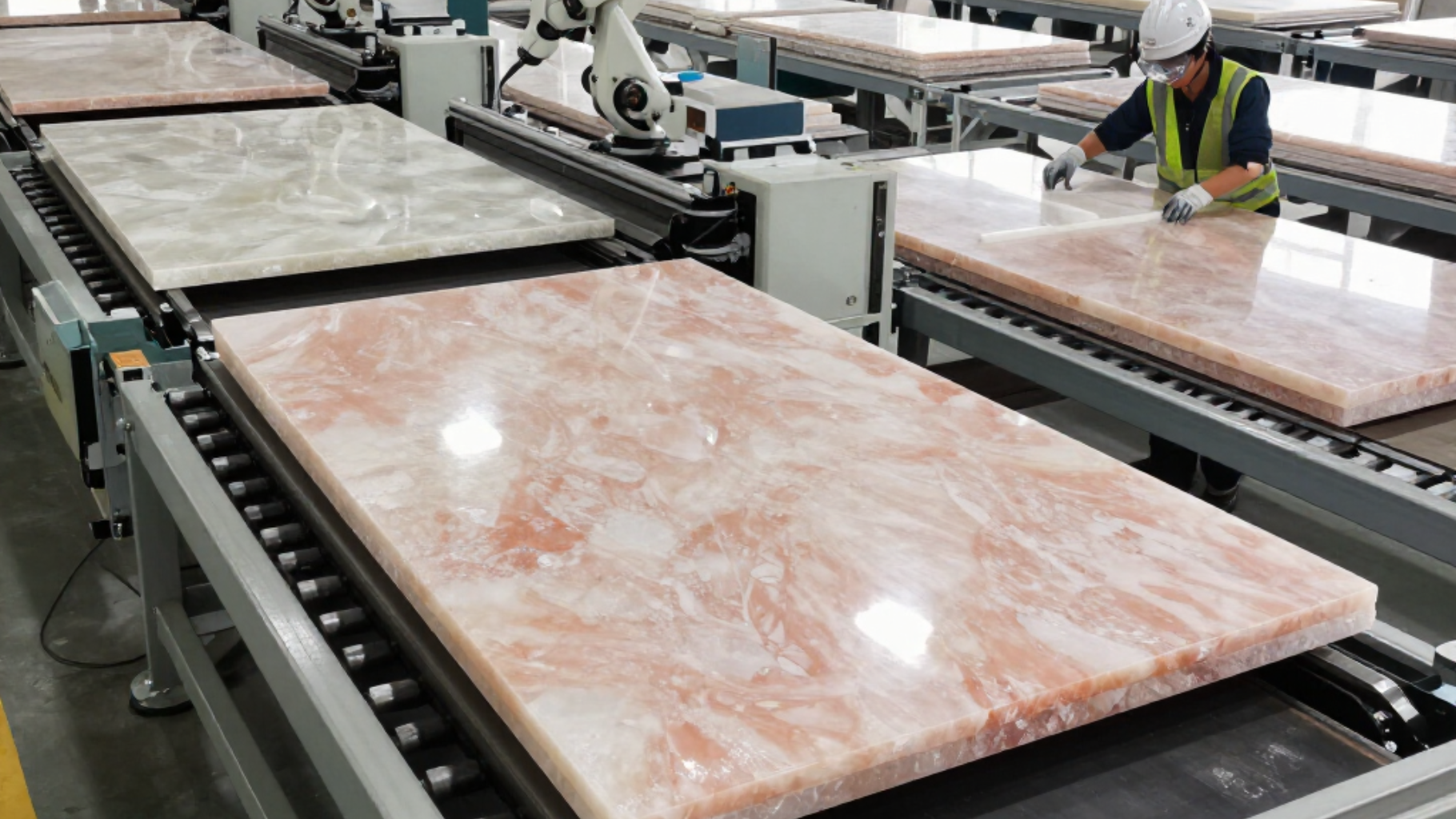
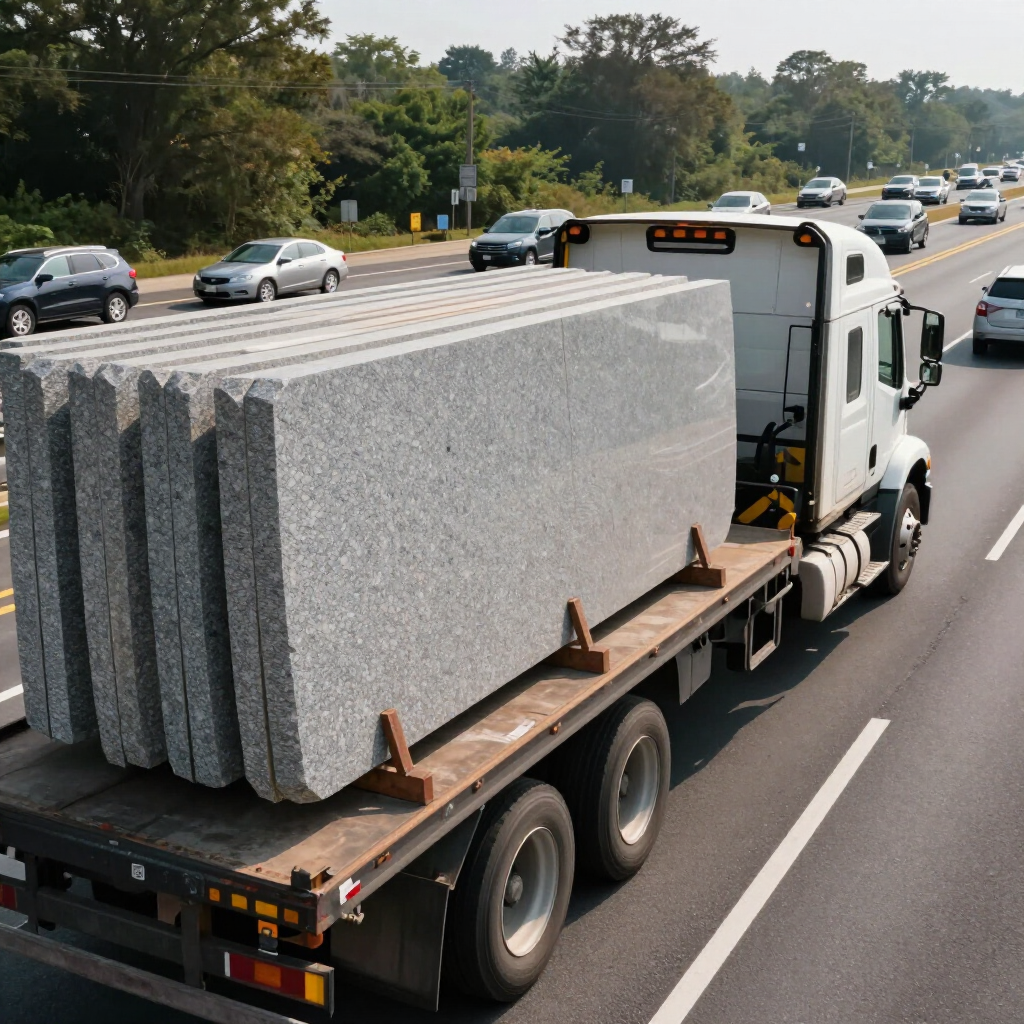
The quarried block now travels — sometimes by flatbed truck over mountain roads, sometimes by rail — to a processing facility, which may be near the quarry or in a major industrial hub. Here, the real transformation begins.
🪚
Gang Sawing
The block is loaded into a multi-blade gang saw — a machine that makes dozens of parallel cuts simultaneously, slicing the block into rough slabs typically 2 cm (¾") or 3 cm (1¼") thick. Water and abrasive slurry cool the blades and flush away debris. This process can take many hours per block.
🔧
Calibration & Resin Treatment
Freshly cut slabs are often uneven. Calibration machines grind them to a consistent thickness. At this point, the back of each slab is typically coated with a clear or colored epoxy resin, which penetrates any micro-fissures and stabilizes the stone. This is standard industry practice and does not affect the finished surface.
✨
Polishing
Slabs pass through a polishing line — a series of progressively finer diamond abrasive heads that grind the surface from rough to mirror-smooth. A fully polished slab typically receives a finish equivalent to around 1,800 grit. The result is the brilliant, light-reflective surface that most consumers associate with granite countertops.
🔍
Quality Grading & Inspection
Finished slabs are inspected for fissures, pitting, color consistency, and pattern match. They are assigned commercial grades — typically First Choice, Standard, and Commercial — that reflect their visual quality. First Choice slabs command the highest prices and end up in premium residential and hospitality applications.
03
Global Logistics: Moving Stone Across Oceans
A finished granite slab from Brazil doesn't simply hop on a truck to your local stone yard. It crosses an ocean — and the logistics involved are a major driver of the final price you pay.
Slabs are bundled into A-frame wooden crates called "bundles," typically holding 8–12 slabs of similar lot and material. These bundles are loaded into standard 20- or 40-foot shipping containers — approximately 15–18 bundles per container depending on slab thickness — secured with strapping and foam padding to prevent movement at sea.
From Brazilian quarry regions like Espírito Santo or Minas Gerais, containers travel to port cities such as Vitória or Santos, then by container ship to U.S. ports — most commonly Miami, Houston, Baltimore, or New York/New Jersey. Transit time from Brazil alone typically runs three to five weeks. From India or China, it can be six to eight weeks or longer.
What Drives the Price of an Imported Slab?
By the time a slab reaches a U.S. distributor, its cost reflects quarry extraction, processing labor, resin and polish materials, inland transport to port, ocean freight, U.S. customs duties (typically 0–3.7% for granite, depending on origin and Harmonized Tariff Schedule classification), port handling, and domestic trucking to the distribution warehouse. Currency fluctuations, fuel surcharges, and port congestion can all shift slab pricing meaningfully — which is why experienced fabricators watch the import market closely.
04
Distribution: The Stone Yard as Middleman
Most granite in the U.S. flows through a two-tier distribution model. Large importers and national distributors — companies like MSI, Arizona Tile, and Bedrosians — buy enormous volumes directly from overseas processors, warehouse it across regional distribution centers, and sell to stone yards, tile shops, and directly to large fabricators. Below them sit regional distributors and stone yards that buy from these importers and maintain local inventory.
When a fabricator like Cabinet Supply Plus visits a stone yard to select material, we're operating at this second tier. The experience is tactile and visual — walking the yard, pulling bundles, examining individual slabs against natural light. No two slabs from the same block are identical, which is why most serious fabricators still prefer to hand-select rather than order from a catalog.
Pricing to fabricators is typically quoted per square foot, with rates varying based on material rarity, grade, thickness, and current inventory levels. Exotic materials — think Calacatta Viola marble, Azul Bahia quartzite, or leathered Black Fusion granite — can carry price tags many times higher than commodity materials like Ubatuba or Santa Cecilia.
05
Arriving at the Fabrication Shop
Once a fabricator has purchased and taken delivery of slabs, the material enters a new phase — one that most consumers are equally unfamiliar with. The slabs are templated against a client's specific layout, cut on a CNC waterjet or bridge saw, edge-profiled, and installed. The processing plant overseas got the stone to a polished blank; the fabricator's job is to turn that blank into a precision-fit architectural element.
This is where knowledge of the upstream supply chain pays practical dividends. A fabricator who understands how slabs were cut knows how to read the grain and maximize yield. Someone who understands resin treatment knows how to advise clients on sealing expectations. And someone who tracks import pricing can give clients honest guidance on whether to buy now or wait — or when a "deal" isn't really one.
The fabricator's job is to turn a polished blank into a precision-fit architectural element. That requires knowing everything that happened before the slab arrived.
The granite industry is global in its reach and intensely local in its execution. A slab may have started as bedrock on a Brazilian hillside, been cut by machinery in Espírito Santo, floated across the Atlantic, and arrived at a Buffalo stone yard before a skilled fabricator turns it into something a family will touch every morning for the next thirty years. That's a remarkable chain of human effort — and it's worth understanding before you choose your countertop.
Questions about material selection, slab sourcing, or what goes into a fair fabrication quote? We're always happy to walk you through it.